

A couple of weeks ago Fin365 wrapped up our 2nd annual Symphony Conference. By all measures it was a resounding success. Two days jam packed with insightful discussion about how technology is the key to helping financial services firms deliver their valuable services to a greater number of Australians.
Of course, AI was the hot topic. So hot that most of the room skipped morning tea to pepper us with questions after our live demo session in which we unveiled the new AI agents we’re developing.
However, reflecting on the conference during my 24-hour flight back to Texas, the thing that stood out most was not the hunger to learn more about AI. Rather, it was the pervasive understanding that AI would only deliver results if the underlying foundation was sound. While 2025’s winner #whynotmicrosoft still made an appearance, #datadatadata became the top hashtag of the conference. Perhaps I shouldn’t have been surprised. Data and process have been two of the key themes in Fin365’s hymnbook since our inception. But, in an age where our industry is once again being inundated with sparkly new toys, it was refreshing to hear such a large choir choosing classics over trendy chart-toppers.
Unfortunately, in the marketplace of ideas, especially the crowded, noisy arena of social media, sizzle almost always outsells substance. And right now, there’s a seductive new melody making the rounds that threatens to drown out the #datadatadata message entirely and replace it with #aiwillfixeverything.
The narrative goes something like this: AI is coming. Traditional CRM (or Saas) is dead. Stop investing in your systems, wait for the agentic revolution, and the shiny new tools that will solve all your problems.
You’ll find versions of this argument in newsletters, on LinkedIn, and on conference stages. Bill McDermott, CEO of ServiceNow, who, perhaps not coincidentally, recently launched a new CRM product, declared agentic AI “an extinction-level event for traditional CRM systems” on Bloomberg last year. The CEO of Reevo and others have echoed this sentiment. The SaaSpocalypse crowd is loud, well-credentialled, and very confident.
There’s just one problem. They’ve described the solution perfectly and then told you not to invest in it.
What is CRM?
The term “CRM” has been so thoroughly colonised by software vendors that most people now treat it as a product category; a Salesforce licence, a HubSpot subscription, a Dynamics dashboard. This conflation is understandable, but not helpful … unless you’re trying to declare its extinction.
CRM (Client Relationship Management) is not a software product. It is a business discipline, i.e. the structured practice of acquiring, understanding, serving, and retaining clients over time.
For the purposes of this argument, and with a focus on the financial services industry, CRM, properly understood, comprises seven interdependent functional pillars:
- Client Data & Identity: who your clients are: their profiles, goals, risk tolerances, family structures, life events, and history. The atomic unit of everything else.
- Files, Documents & Activity: the longitudinal record of everything that has happened in the relationship: meeting notes, advice documents, compliance records, signed authorities, review packs, and audit trails. The answer to “what has actually happened with this client, and when?”
- Workflow & Process Management: the defined, repeatable sequences of actions that move a client relationship forward: onboarding flows, review cycles, compliance checklists, paraplanning handoffs, implementation steps.
- Client Communications & Engagement: the managed cadence of outreach, education, and engagement across the client lifecycle: review reminders, targeted campaigns, life event triggers, referral programmes.
- Reporting, Intelligence & Performance: pipeline visibility, retention metrics, advice capacity utilisation, compliance adherence, and business health dashboards. The feedback loop that turns outputs into decisions.
- Integration & Ecosystem Connectivity: the APIs, middleware, and data feeds that connect client data across portfolio platforms, advice tools, document management systems, and communication platforms. The nervous system of the operating stack.
- Compliance, Consent & Governance: the accurate, auditable, tamper-evident record of client consent, advice given, disclosures made, and obligations met. Non-negotiable in a regulated industry.
None of these pillars are going away. Not one of them becomes irrelevant because AI is getting smarter. In fact, and this is the central argument of this article, every single one of them becomes more important as AI becomes more capable.
Why the sensational claims?
Let’s take a moment to examine where this narrative is coming from, and who benefits from it.
Bill McDermott’s “extinction-level event” declaration arrived on Bloomberg at the same time ServiceNow was launching its own CRM product, built from the ground up on agentic architecture. McDermott is a brilliant CEO and a masterful communicator. He is also, in this instance, doing what brilliant CEOs do: framing a market shift in terms that position his company’s new product as the inevitable winner.
Similarly, the SaaSpocalypse narrative, amplified by a sharp correction in SaaS stock prices through late 2025 and early 2026, has been enthusiastically adopted by consultants, analysts, and newsletter writers whose incentive is to appear ahead of the curve. The more alarming the prediction, the more newsletter opens, the more conference keynote slots.
This is not to say the underlying technology shift isn’t real. It absolutely is. AI is transforming how software is built, sold, and used. Agentic systems will change the way client-facing workflows are executed. These are genuine and significant shifts.
But “the tools are changing” is a very different claim from “your data, your files, your processes, and your client relationships no longer matter.” The first is insightful. The second is reckless.
Without a hint of irony
Humorously (not really), the very same voices telling you AI will make your CRM obsolete are, in the same breath, telling you that AI requires clean data, integrated systems, accurate activity records, and well-defined workflows to function.
They’re right about the second part. They just haven’t connected the dots.
Let’s be precise about what AI needs to deliver value in a client-serving business:
- Structured, accurate client profile data – so it knows who it’s working with
- A complete activity and document history – so it understands the context of the relationship
- Defined workflow rules and process logic – so it knows what actions to take and when
- Integration across the technology stack – so it can pull data from advice platforms, communication tools, and portfolio systems
Translation? AI NEEDS your CRM. Or, as the old saying goes Garbage In, Garbage Out[1]
A firm that neglects its CRM because “AI is coming” is like a restaurant that stops stocking the pantry because a robot chef is arriving. The robot still needs ingredients.
What “Systems of Action” actually need to act
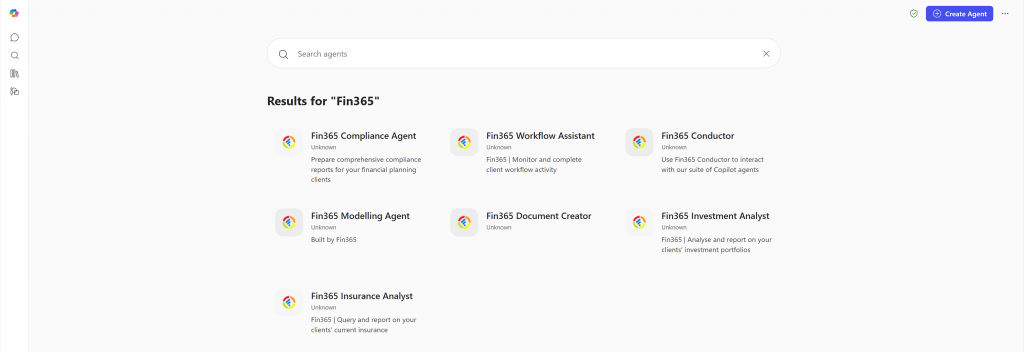
Consider your client review process. In the world of agentic AI, a Copilot agent will trigger the review workflow automatically, pull portfolio data, run analysis against client goals, highlight misalignment between asset allocation and risk profile, pre-build the review document, check compliance, propose a meeting time, and draft a client email.
That is a remarkable jump in tech capability. And the best news is it’s almost here. We showed working examples of this exact scenario at Symphony.
But here is what that agentic system needs to do any of that:
- It needs to know the client’s goals (profile data)
- It needs to know what was discussed in the last review (activity history)
- It needs to know what the review workflow looks like (process management)
- It needs to be able to send the email (communications infrastructure)
- It needs to check compliance (governance records)
- It needs to pull portfolio and research data from external systems (integration)
The agentic AI is not replacing your CRM. It is sitting on top of it. It is consuming it. It is entirely dependent on the quality of what lives inside it.
The firms that will benefit most from agentic AI are not the ones who waited. They are the ones who have a system that can consolidate all of the above into a single source of truth, and who have made the necessary investment in cleaning their data, structuring their activity records, defining their workflows, and connecting their systems; so that when the agentic layer arrives, it has something intelligent to work with.
The firms that wait will hand their AI a rubbish tip and wonder why it isn’t producing gold.
So, What Should You Actually Do?
It is true that poorly managed technology transformation can be costly. Fin365 has completed hundreds of customer migrations, and the evidence is clear and consistent with third-party research:
- Tech transformation failure is generally due to a combination of factors such as poor change management, inadequate user adoption planning, and insufficient executive sponsorship; not the act of switching technology.[2]
- A well-designed CRM, correctly embedded into your business, will deliver a significant return on investment[3],[4].
But the question was never “to switch or not to switch”. That’s a distraction.
The real question is: is your CRM, as a discipline across all foundational pillars, fit for the world that’s coming?
If your client data is incomplete, duplicated, or stale – fix it. Not because your current platform demands it, but because every platform and every AI tool you will ever use demands it.
If your activity records are inconsistent or missing – address it. The longitudinal story of each client relationship is irreplaceable context that no AI can reconstruct from scratch.
If your workflows are undocumented, inconsistent, or living in people’s heads – define them. Agentic AI can only automate what has been made explicit.
If your systems aren’t talking to each other – connect them. A well-integrated stack of average tools will consistently outperform a shiny new monolith that operates in isolation.
And if your current platform is genuinely holding you back from doing any of the above, then yes, consider your options. But do it with clear eyes about what problem you’re really solving, not in a panic driven by someone else’s product launch narrative.
The Bottom Line
CRM is not dying. The discipline of knowing your clients, recording your interactions, managing your processes, and communicating with intent is not going anywhere. If anything, it is becoming the most strategically important investment a client-serving business can make; precisely because AI has raised the stakes on data quality to a level the industry has never seen before.
Don’t let the noise of the moment distract you from the fundamentals.
Your clients are real. Their data matters. Their history with your firm is irreplaceable. The systems that capture, organise, and activate that knowledge, whatever form they take, are not an obstacle to the AI future.
They are the prerequisite for it.
Sources
[1] Why 74% of AI Projects Fail: The ‘Garbage In, Garbage Out’ Data Problem
[2] CRM Success Requires Focus On People, Not Only Technology
[3] What is the average CRM ROI? – Johnny Grow
[4] The Ultimate List of CRM Statistics for 2025 | FounderJar
About Fin365
Fin365 is the leading provider of enterprise grade, AI-powered data management & workplace productivity software for the financial services industry.
Leveraging the power of Microsoft’s enterprise technologies, Fin365 has added the necessary data intelligence, connectivity and functionality required to turn these cutting-edge tools into instantly useful solutions that facilitate measurable business transformation for our customers.
Media Contact
E: [email protected]